
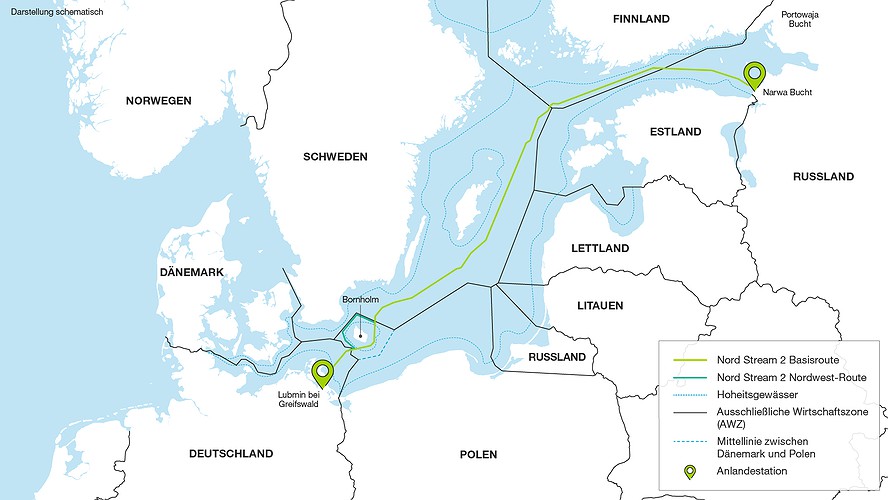
Denmark will most likely ask Nord Stream 2 to submit a third permit application, which will further delay the project and lead to additional financial losses for Russia's Gazprom, the Danish newspaper Politiken reports, citing informed sources.
In August 2018, Nord Stream 2 applied for an alternative route north of Bornholm, far beyond the Danish territorial seas, to protect its interests.
Meanwhile, the US has once again opposed the project and led Europe's "excessive dependence" on Russian energy.
The US is now apparently preparing to impose sanctions on EU companies that co-finance the Russian Nord Stream 2 pipeline to Germany and companies involved in laying the pipes in the Baltic Sea, the US daily The Wall Street Journal reports, citing unnamed sources in the US. The sanction may cause serious problems for the companys involved such as German Wintershall and Austrian OMV.
The US says the pipeline poses a strategic risk to Russia's energy dependence. The German government has so far tried to stand firm and continue with Nord Stream 2. Germany even succeeded in breaking the resistance within the EU, which mainly came from France.
However, Austrian OMV seems to distance itself already from Germany by looking for alternative partnerships with Russia.
OMV welcomes the possible implementation of the Turkish Stream 2 project, Chief Executive Officer of the Austrian oil and gas company Rainer Seele told reporters in Moscow.
“I am interested in any pipeline running to Austria. And any pipeline running to Austria is a good pipeline,” he said when asked about the interest in the project in case of its implementation.
Gazprom CEO Alexei Miller told TASS earlier that he did not rule out that the Turkish Stream 2 natural gas pipeline project would be implemented in case of demand and required agreements in place.
The Turkish Stream project envisages the construction of a gas pipeline across the Black Sea to the European part of Turkey and farther to the border with Greece. Gas deliveries via the first stretch of the gas pipeline are designed to meet the requirements of the growing Turkish market, while the second stretch is planned to deliver gas to the countries of Southern and South-Eastern Europe. Gazprom views Greece, Italy, Bulgaria, Serbia and Hungary as potential markets. Each line will have a capacity of 15.75 bln cubic meters of gas per year. First supplies are planned for the end of 2019.