
WASHINGTON/BRUXELLES, May 15 (WNM staff/Newswires) - Several US senators are stepping up their efforts against the planned Nord Stream 2 Baltic Sea gas pipeline. On Tuesday they proposed a bill imposing travel and financial sanctions on companies and individuals involved in the construction of the pipeline. Not only the companies directly involved in the pipeline would face consequences. European ships involved in the construction of a controversial gas pipeline from Russia to Germany could also be subject to U.S. sanctions.
The bill was sponsored by Republicans Ted Cruz, John Barrasso and Tom Cotton and Democrat Jeanne Shaheen.
The bill would put under scrutiny two companies that have contracts to lay pipes for Nord Stream 2: Switzerland’s Allseas and Italy’s Saipem, two of only a handful of companies worldwide that operate pipe-laying vessels. It also ratchets up pressure on Gazprom and the five companies partnering on Nord Stream 2: Uniper and Wintershall from Germany, Anglo-Dutch Shell, OMV from Austria, and Engie of France.
As Foreign Policy Magazine explains: "Under the bill, people who continue to sell or lease boats for use in Nord Stream 2 construction would be subject to a U.S. travel ban, and any assets in the United States would be frozen. The bill also allows for a range of penalties to be imposed on people who provide financial or technical support services or insurance to the vessels."
The bill takes aim at the vessels used to lay deep-sea pipelines, which involves technological know-how that Western energy companies have but that Russia lacks. “That’s one of the few areas where, essentially [Russia’s national gas company] Gazprom lacks that technical expertise and technology in order to build the pipeline projects,” said Agnia Grigas, an expert on Eurasian energy issues with the Atlantic Council, a Washington-based think tank, according to Foreign Policy Magazine.
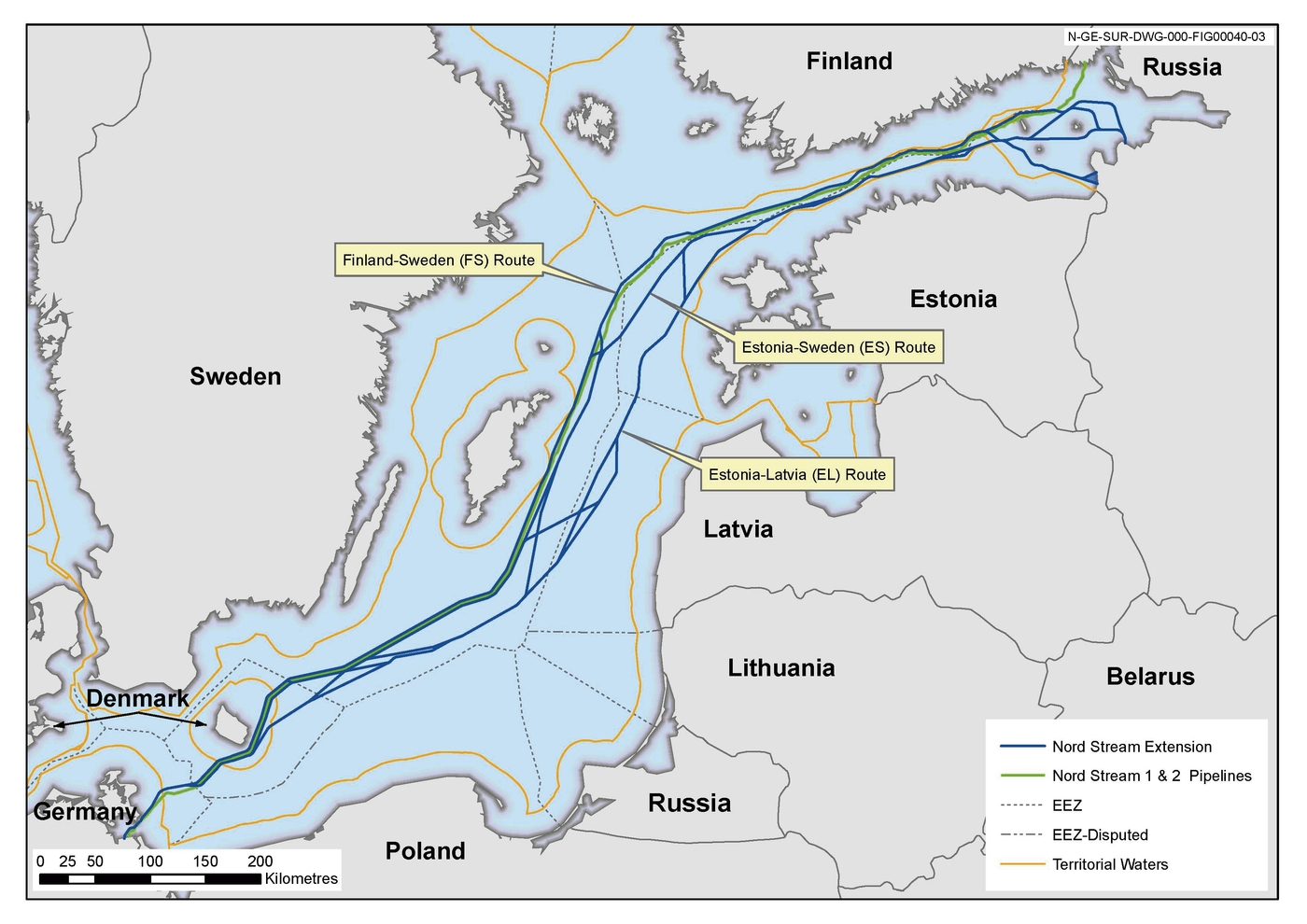
The Nord Stream project -- operational since 2011 with an annual capacity of 55 billion cubic meters -- brings Russian gas directly to Germany via the Baltic Sea. The Nord Stream 2, which plans to become operational by the end of 2019, also has the same annual capacity and runs almost parallel to the first pipeline route. Together they will meet the annual gas demand of a quarter of the European continent.
On May 4, U.S. President Donald Trump, in a joint statement with Slovakian Prime Minister Peter Pellegrini, strongly criticized the project and said it would leave some countries vulnerable.
“Our countries also affirm that energy security is fundamental to national security. We reiterate our opposition to the use of energy projects as geopolitical weapons, including Nord Stream 2,” the statement read.
Furthermore, the U.S. Ambassador to Germany, Richard Grenell, warned German companies that they could be punished if they continue to collaborate with Russia on the project.
“Regarding sanctions, whatever we do is based on the rule of law. The sanctions bill is from August 2017, and the implementation of these sanctions are specified in guidance delivered by the state department in October 2017,” he said.
Negotiations about EU Gas Directive
While the U.S. is still opposing the project, Nord Stream 2 AG, the operator of the Nord Stream 2 gas pipeline construction, has received a follow-up letter from the European Commission (EC) on its request concerning the EU Gas Directive. Currently the company is considering its further steps and plans to respond in due time, Nord Stream 2's EU representative Sebastian Sass told TASS on Tuesday.
“As requested by Nord Stream 2, the European Commission has confirmed its willingness to meet and discuss the issues raised by Nord Stream 2 in its letter to the Commission (12 April). We will assess our further steps and respond to the Commission in due time,” he said.
On Monday, the EC’s press service told reporters that the Commission had responded to the request by Nord Stream 2 on amendments to the EU Gas Directive, saying that its services are ready to meet the project’s promoters and listen to their arguments.
On April 12, the operator submitted a letter to the head of the European Commission, Jean-Claude Juncker, seeking an official confirmation that the conditions stipulated by the amended Gas Directive applied to Nord Stream 2 would not be worse than those applied to similar gas pipelines supplying gas to the EU, investments in which were made long before the amendments to the directive were adopted.
Otherwise, the company sees a threat to the interests of investors who have already invested 5.8 bln euro in the project, and may go to court to protect them, Matthias Warnig, executive director of Nord Stream 2 AG, emphasized in the letter.
Under the amendments to the EU Gas Directive, the rules governing the European gas market apply to pipelines from third countries. In particular, one company is not allowed to act as a gas producer and gas transporter at the same time. Moreover, the access to the Nord Stream 2pipeline should be granted to other companies.
One of the articles of the Directive provides for derogation (partial lifting of requirements) with respect to offshore gas pipelines, which are “completed” before new provisions come into force in the summer of 2019. The derogation allows EU member states not to apply the key provisions of the Gas Directive (separation of activities and third party access to the pipeline) to such gas pipelines.
According to the European Commission, the need to take into account the legitimate expectations of existing operators, as well as the fact that the EU did not previously have specific rules applicable to gas pipelines from third countries can be regarded as the ground for derogation, a representative of Nord Stream 2 AG, the project’s operator, said earlier.
According to the official, when the European Commission submitted amendments for consideration, it clearly stated that Nord Stream 2 was the only project at an “advanced” stage, investments in it had been made before the adoption of amendments to the EU Gas Directive.
If the Nord Stream 2 is not subject to the same legal regime as other similar gas pipelines, it would be a violation of international law and EU legislation, in particular non-fulfillment of obligations under the Energy Charter Treaty regarding Nord Stream 2 AG as investor, the official noted.