
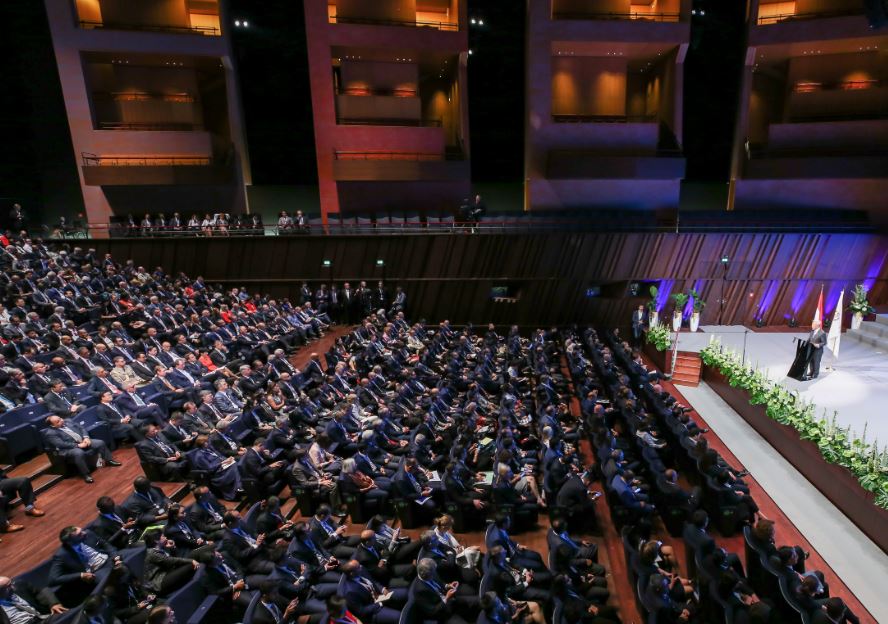
LUXEMBOURG, July 15 (WNM) - The Asian Infrastructure Investment Bank (AIIB) has made significant achievements in the past three years since it went into operation.
The South China Morning Post writes:
The development of the AIIB is widely seen as a diplomatic win for China, which holds the largest voting rights in the bank with a stake of slightly less than a third. The United States, which is not a member, sees the bank as a tool for Beijing’s geopolitical aspirations, but China has successfully persuaded Washington’s key allies – including Britain – to join the lender.
Alicia Garcia-Herrero, chief economist for the Asia-Pacific at Natixis, said the AIIB was an agency promoting China’s interests, just as the World Bank and International Monetary Fund had long promoted US interests – but with an important difference. “The US did not have enough of a shareholder share to fully dominate the World Bank and [International Monetary Fund], which is a mistake China has not fallen into with the AIIB,” said Garcia-Herrero, who is also an adviser to the ADB.
“The fact that the US has not gotten into the AIIB only helps China control the AIIB even more tightly – in that regard, the US decision is a mistake.”
By the end of last year, the bank, with a stated capital base of US$100 billion, had granted US$7.5 billion worth of loans for 35 infrastructure projects in 13 countries, including Indonesia, India, Pakistan, Turkey and Egypt.
The potential for infrastructure financing is huge. A 2010 report by the ADB estimated that Asia alone would need US$8 trillion to build infrastructure for the region’s development before 2020.
The AIIB has established a fundamental operating system and nurtured its own enterprise culture. It also managed to expand the loaning scale and obtain the status of United Nations Permanent Observer, said AIIB President Jin Liqun.
These achievements resulted from the concerted efforts of all AIIB members and close cooperation with other banking institutions and private sectors, including the World Bank, the Asian Development Bank and the European Bank for Reconstruction and Development, he added.
Jin made the remarks on the sidelines of the fourth annual meeting of the AIIB's Board of Governors, which was concluded in Luxembourg on Saturday. During the meeting, the AIIB expanded its membership to 100 with the approval of the African newcomers of Benin, Djibouti and Rwanda.
The 100 members have various appeals, and a relatively large difference in their appeals exists between the developing countries and the developed, Jin said. "We have limited funds, so it's hard to solve all the problems overnight."
The China-initiated multilateral financial institution began operation in January 2016 with 57 founding members, with an agenda focused on supporting sustainable development through infrastructure and other productive sectors in Asia and beyond.
So far, the volume of its approved financing has expanded to 8.5 billion U.S. dollars and covered dozens of programs.
Jin's remarks at the conference:
We in the Asian Infrastructure Investment Bank are honored to be invited to this beautiful country for our fourth annual meeting, the first to be held in Europe and outside Asia. I would like to thank you, Grand Duke, Prime Minister, Finance Minister and your people, for your generous hospitality. Since we arrived, we have been overwhelmed by and immersed in an atmosphere of friendship, harmony and liveliness.
Luxembourg was the first among the European countries to join the preparation to create a new multilateral development bank. From the beginning, Luxembourg played an important role in designing and shaping AIIB’s governance for the 21st century. Three and a half years into our operation, it is time we came to Luxembourg, and to Europe, to inform our European stakeholders about how we have developed.
Finance Minister Pierre Gramegna, I recall vividly our conversation on the creation of AIIB. Your insights and frankness touched me immensely. You were clear-cut in your position: What AIIB should be. What it shouldn’t be. What AIIB should and shouldn’t do. I am sure your ideas about the identity and behavior of the proposed bank represented the opinion and sentiment of Luxembourg and its people. Later on, when touring other European countries, what I heard from prospective shareholders convinced me that your words reflected the broader European perspective.
I would like to take this opportunity with you here—Grand Duke, Prime Minister and Finance Minister—to announce AIIB’s intention to list the Euro Medium Term Note program on the Luxembourg Stock Exchange.
AIIB was conceived and born in Asia, but it owes its birth and growth to the wisdom and labor of all the founding members. European shareholders have prodigiously contributed to the creation of this new MDB. As a result, AIIB holds distinctively European characteristics. And—in adherence to our values of being lean, clean and green—we set the bar at par with the governance structure of other MDBs, of which European countries are founding members. Those values show that we have zero tolerance for corruption and that we promote the green economy.
There has always been a strong bond between Asian and European countries. Asia and Europe share the same vast continent. We are physically bound to each other. Yet tough terrain impedes this geographical affinity, hampering exchanges in commerce, investment and culture. Now is the time to improve our connectivity in all its dimensions.
AIIB is mandated to improve connectivity among its members and among the regions. But operations in infrastructure investment must adapt and evolve. Emphasis should be placed on a green approach to building infrastructure. Project implementation should be green. Operation and maintenance of facilities should be green. Overall growth and development stemming from infrastructure should be even greener.
On December 12, 2015, just a few weeks before AIIB became operational in January 2016, about 200 countries concluded negotiations on the Paris Agreement. It was within this atmosphere of multilateral efforts to address the formidable challenge of climate change that our Bank was born. Climate change mitigation is crucial for all of us and, more importantly, for generations to come. There is no alternative but to tackle this challenge head-on.
We are now faced with a global situation far more complicated than what it was three years ago. Overall, global growth is stabilizing, but protectionism and disruption of trade and cross-border investments constitute a major risk to many countries. Many low-income countries are particularly vulnerable to market turbulence. Their exports are likely to suffer setbacks; their debt sustainability adversely affected.
The complexity of our global, political and economic situation should not inhibit us from investing in priority projects where our members need them most. Slower investment in crucial sectors will compromise long-term development. A well-coordinated investment program in infrastructure and other productive sectors in low-income countries will boost growth. It will create jobs and reduce poverty. It will empower women. This will then drive a higher level of development where governments can afford more investment in education and health, ultimately realizing long-term economic and social achievement.
AIIB and other MDBs have a crucial role to play in this regard. Today, the world is not short of liquidity. Asia has consistently maintained a high savings rate, although great variance exists within the region or across countries.
At present, risk-averse investors are allocating money to developed market equities—with major indices at or near all-time highs—and to low-risk fixed income. This is driving bond yields across Europe into marginally positive territory.
The main issue is that the mechanisms for turning these vast savings pools into long-term investments is, sadly, still limited. Asian equity and fixed income capital markets are still at an early stage of development in terms of depth, breadth and impact.
Infrastructure projects are typically large, require a long gestation period and demand a stable, predictable policy and regulatory climate amenable and conducive to such investment.
Economists in MDBs, including AIIB, have done research and analysis on the constraints affecting growth in developing Asia. They still point to lack of infrastructure investment as the main cause.
A converging view is that developing countries should invest around eight percent of their GDP in infrastructure. This is a level of investment that not only meets basic needs, but also helps countries catch up economically. For every dollar spent in gross capital formation, 40 cents should be spent on infrastructure. While some Asian economies have increased their investments to six to seven percent of GDP, other economies are struggling, particularly countries at low income levels.
Estimates vary, but our best analysis points to many lower and lower-middle income members needing to boost infrastructure investment by a third. Unable to mobilize private capital for infrastructure investment, they must consider allocating public resources for that purpose without putting pressure on their public balance sheets.
While it is important for developing economies to raise their infrastructure investment, it must be done sustainably, not least on the issue of debt. Public and external debts of many countries in Asia have risen. Especially so for smaller economies, where sometimes large infrastructure investments can increase debt-to-GDP ratios quickly. Investing in high-quality infrastructure is important. New investments must increase a country’s capacity to service debts, not just having debts to service. Quality means selecting projects with high economic returns, designing them well and financing them sustainably. Quality means ensuring that projects benefit the local population, do no harm to people or the environment and leave no chance for corruption. This is what it means to be lean, clean and green.
For those members with a high level of debt, we have to strike a proper balance between budget control to ensure debt sustainability and well-coordinated, well-designed infrastructure investments to pave the way for long-term development. Commercial sources of capital may run shy from these countries, but AIIB must be an even more supportive partner capable of meeting their special needs. These countries should not be left behind.
This is exactly the challenge facing AIIB and our client members. This is the very reason why we need to ramp up our concerted efforts to help these countries. We have a sense of urgency to fulfil our duty. Over the last three years and a half, we at AIIB—the Board of Directors, the Management and the staff—have worked together in close collaboration to make this Bank ready for the challenge.
We have noticed that while existing barriers to infrastructure development are being rolled back, new ones are raised. This is a cause for concern. The collective wisdom, knowledge and influence to removing these impediments lies in this very room. It lies within all of you. Governors, Directors, policymakers, private financiers, civil society and media are all here today. By working together, we have the power to remove these roadblocks. Together we can create domestic reforms, perform policy coordination and think holistically about country and regional infrastructure and supporting facilities.
Cooperation and Connectivity is the theme of our annual meeting for the simple reason that infrastructure is complex, particularly when it comes to connectivity projects. It will take all of us who are here today to work together to move the needle. We need concrete action today.
MDBs are here to help smooth over these challenges. We believe infrastructure bottlenecks can only be effectively resolved through partnership. Through risk-sharing. Through international cooperation.
I met President Malpass of the World Bank in April when I discussed with him the cooperation between our two banks and more broadly about the collaboration among all MDBs. I shared similar conversations with President Nakao of ADB and President Chakrabarti of EBRD, among others. I pay special tribute to President Hoyer of EIB, who has kindly hosted AIIB, our Board of Directors and Management this week. We are looking forward to deepening our partnership and cofinancing.
We are going to expand our programs beyond Asia because Asia cannot sustain itself without working with other regions. We live in the same small village. We are all neighbors, irrespective of the oceans that separate us geographically. Governors and ministers, if we have not done anything yet in your region and individual countries, please understand that we have you and your people on our minds. We are moving toward you.
MDBs also need to evolve and adapt to new trends in financing infrastructure. How we cooperate, govern ourselves and support our clients must not stagnate, or we risk missing opportunities. Many of our recent projects are evidence of our expanding capabilities. They show our commitment to partnership and working with our clients to bring well-designed projects to fruition:
We launched an ESG Enhanced Credit Managed Portfolio that aims to develop infrastructure as an asset class, develop debt capital markets for infrastructure and promote the integration of Environmental, Social and Governance principles in fixed income investments in Emerging Asia.
We are supporting our clients to develop high-quality infrastructure projects with an eye on mitigating climate impact, like our Mandalika Urban and Tourism Infrastructure Project. The project is an ideal fit for Indonesia’s economic profile.
We are making our green impact felt with projects like our on-lending facility to finance mid- and large-scale solar and wind power projects in India.
I am delighted that at this annual meeting, AIIB will introduce its variable spread loan product. This will give borrowers the flexibility to select interest terms that are consistent with their sovereign debt management strategy and suited for their debt servicing capability. This year, we will also introduce local currency products in selected currencies, providing more options to borrowers.
Building off the triple-A credit ratings received from all three major credit rating agencies, we issued our debut Global Dollar Bond this year. Investors from around the world participated in the bond, and as such it priced at the tightest levels in line with our global MDB peers. This positions AIIB as a “premium supranational.”
In December last year, the General Assembly of the United Nations granted AIIB permanent observer status. This is an important milestone for the Bank. That such a privilege was granted with the full support of the international community, including states that are not members of AIIB, underscores the high expectations that the Bank will make a real and lasting contribution to economic growth, development and enhanced connectivity in Asia.
We are looking forward to our ever-growing membership. Tomorrow, the Board of Governors will consider, and we hope will approve, the membership of new applicants, bringing our total number of approved members to 100. This will be another significant landmark for the Bank.
Collaboration and partnership must extend to all involved. AIIB is inclusive, open and diverse in its views. In this 21st century world, we must be flexible and agile if we want to achieve the great goals set out for our new organization. Now in the final year of our startup phase, the basic building blocks of the Bank are in place. We have achieved much in our early development, but a lot of heavy lifting still needs to be done.
Governors, ministers and board members, we see it as our job to position AIIB to meet the challenges of today and the future. We are doing our utmost to steer our business to a stronger place with each passing year.
I am heartened by your presence here in Luxembourg because I have seen the power of collaboration in action. Yet, we have only just begun. I believe the future for Asia is bright. With your help, we have become the Bank striving for connectivity in Asia. With your help, we will become the Bank that connects Asia to the world.
Next conference in China
The AIIB announced that its fifth annual meeting will be held in Beijing in July 2020. "We appreciate the role of China in initiating the establishment of the AIIB and the strong support it has provided since its inception," said AIIB Vice President and Corporate Secretary Sir Danny Alexander. China is among the AIIB's founding members and host to the bank's headquarters.
"By 2020, the bank will enter its fifth year of operations, with 100 approved members and 8.5 billion U.S. dollars in investments for 45 projects in 18 countries," said Alexander.
The 2020 AIIB annual meeting marks the transition from the start-up phase to the AIIB's future growth and expansion.
"We are honored to host the fifth AIIB annual meeting in Beijing and look forward to working with all members in scaling up efforts to build a professional, efficient and clean 21st-century multilateral development bank. I welcome you all to Beijing," said Liu Kun, finance minister of China.
The China-initiated multilateral financial institution began operation in January 2016 with 57 founding members, with an agenda focused on supporting sustainable development through infrastructure and other productive sectors in Asia and beyond.