
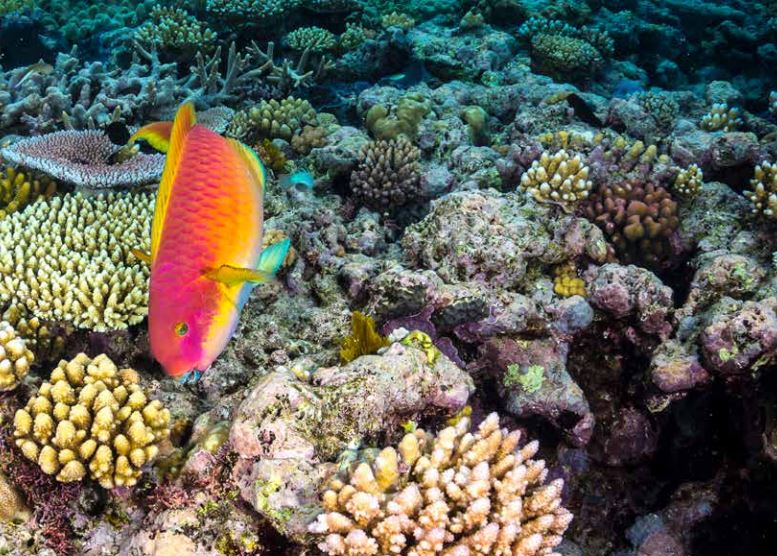
TOWNSVILLE, August 30 (WNM) - The Great Barrier Reef is a natural treasure and one of the world's best managed marine areas, but like all tropical coral reefs around the world it’s facing serious threats.
The official Great Barrier Reef Outlook Report 2014 and strategic assessment found the Reef is an icon under pressure from:
poor water quality from land-based run-off
remaining impacts from fishing.
In recent years, a series of major storms and floods have affected an ecosystem already under pressure. Crown-of-thorns starfish outbreaks and marine debris are also affecting the area.
The pressures from climate change, when combined with these additional pressures, are resulting in dramatic, system-wide declines in the Reef’s condition.
Climate change impacts on coral reefs are predicted to worsen and critically affect the survival of coral reefs globally without the strongest possible climate change mitigation.
The Reef is already experiencing the consequences of climate change — most notably, two consecutive years of severe mass coral bleaching in 2016 and 2017.
Coral bleaching, and a severe tropical cyclone that occurred in 2017, impacted 80 per cent of the Reef over the last two years.
The Reef is facing a range of threats over time, scale and duration, and the cumulative impact of these threats has the potential to further weaken its resilience.
This is likely to affect its ability to recover from serious disturbances, such as major coral bleaching events, which are predicted to become more frequent in the future.
While the Great Barrier Reef remains a vibrant, beautiful ecosystem of immense value to Australians and the world, global and local actions are needed to protect the Reef.
Addressing key threats
The Great Barrier Reef Marine Park Authority is the key management agency for the Great Barrier Reef and works with government, industries and communities to build reef resilience.
We use a range of tools — including on-ground park management, policies, programs, partnerships and regulations — to maintain the delicate balance between protecting and enabling sustainable use.
The Australian and Queensland governments' Reef 2050 Long-Term Sustainability Plan provides an overarching framework for protecting the Reef.
It draws on our strategic assessment and 25-year management plan and the findings of our Outlook Report, which together provide the largest, up-to-date information on the Reef's health and management.
After the mass coral bleaching events of 2016 and 2017, in December 2017 the Marine Park Authority launched its Great Barrier Reef Blueprint for Resilience which draws on the input to the Great Barrier Reef Summit convened by the Authority in May 2017.
The blueprint outlines 10 initiatives with actions that deliver maximum benefits for Reef resilience, with a clear message: ‘Together we can secure the future of the Great Barrier Reef — but we need to try harder, do more and act now’.
Implementation of the blueprint initiatives is now underway — for example, the Australian Government committed substantial new funding for expansion of our field management program and increasing efforts to control outbreaks of crown-of-thorns starfish.
Climate change policies review
The Great Barrier Reef Marine Park Authority provided input to the Australian Department of Environment and Energy on the climate change policies and review discussion paper. The Authority's submission reinforces the importance of Australia leading global efforts to meet the goals of the Paris Climate Change Agreement.
State of the climate
In December 2018, the Bureau of Meteorology and CSIRO released their fifth, biennial State of the Climate report.
It draws on the latest monitoring, science and projection information to describe variability and changes in Australia’s climate.
Observations and climate modelling paint a consistent picture of ongoing, long-term climate change interacting with underlying natural variability.
The report explains:
The Great Barrier Reef is a vast and spectacular ecosystem and one of the most complex natural systems on Earth. The Great Barrier Reef Region’s natural beauty and natural phenomena endure, but they are showing signs of deterioration in several areas. In 2009, the Reef was considered to be at a crossroads between a positive,
well-managed future and a less certain one. In 2014, it was seen as an icon under pressure, with continued efforts needed to address key threats. Since then, the Region has further deteriorated and, in 2019, Australia is caring for a changed and less resilient Reef. The challenge to restore Reef resilience is big, but not insurmountable. However, it requires mitigation of climate change and effective implementation of the Reef 2050 Long-Term Sustainability Plan (Reef 2050 Plan).
The scientific evidence is clear: initiatives that will halt and reverse the effects of climate change at a global level and effectively improve water quality at a regional scale are the most urgent to improve the Region’s long-term outlook. More than ever before, uses of the Region must be sustainable and effectively managed. To protect and restore habitats, species and heritage values, management agencies must complement proven techniques with innovative approaches that are targeted, science-based and risk-managed.
Climate change is escalating and is the most significant threat to the Region’s long-term outlook. Significant global action to address climate change is critical to slowing deterioration of the Reef’s ecosystem and heritage values and supporting recovery. Such action will complement and greatly increase the effectiveness of local management actions in the Reef and its catchment.
Gradual sea temperature increase and extremes, such as marine heat waves, are the most immediate threats to the Region as a whole and pose the highest risk. Sea temperature extremes caused successive mass bleaching events in 2016 and 2017. These events led to unprecedented and widespread coral loss, and flow on effects to fish and invertebrate communities. Such impacts also weaken Traditional Owners’ enduring connection to sea country and the quality and quantity of economic and social wellbeing provided by the Reef.
Inshore water quality is improving on a regional scale, but too slowly; poor water quality continues to affect many inshore areas of the Reef. The rate of reduction of pollutant loads has been slow, reflecting modest improvements in agricultural land management practices. Future initiatives need to deliver timely, best practice agricultural land management over a wider area to improve water quality.
Natural values of the Region include species, habitats and ecosystem processes. Overall, habitats are assessed as being in poor condition. Habitat loss, degradation and alteration have occurred in a number of areas, substantially affecting populations of some dependent species. For example, the significant and large-scale impacts from record- breaking sea surface temperatures have resulted in coral reef habitat transitioning from poor to very poor condition. Not all habitats have been equally affected and their condition varies across the Region. For instance, coral reefs that have escaped impacts of bleaching, cyclones and crown-of-thorns outbreaks remain in good condition.
Concern for the condition of the Region’s species is also high; many species and species groups are assessed as being in poor to very poor condition. Species assessments reflect both ongoing effects of past significant population declines (for example, from historical commercial harvesting of dugongs and turtles) and current impacts that add further pressure. Humpback whales and the southern green turtle population continue to recover and the breeding rate of urban coast dugongs has improved since the impacts of cyclone Yasi and floods in 2011.
The Region relies upon the healthy functioning of a range of physical, chemical and ecological processes, and connection to functioning coastal ecosystems. Of the 31 ecosystem health components assessed, about 60 per cent remain in good to very good condition, but the remainder are in poor to very poor condition. Some critical ecosystem functions have deteriorated since 2014, mainly due to declines in ecological processes, such as symbiosis and recruitment, and deterioration of some physical processes, such as sea temperature and light. Some processes important to replenishment and recovery of species and habitats, such as currents, connectivity and primary production, remain in good to very good condition.
Many of the Region’s heritage values are closely tied to the condition of the ecosystem, particularly Indigenous heritage value. Overall, many heritage values remain in good condition, with the exception of Indigenous heritage and some aspects of historic heritage, which are assessed as being in poor condition. Community awareness and appreciation of the Region’s Indigenous and historic heritage values are important to their protection and resilience.
While significant work has occurred, identification and monitoring of the broad range of Indigenous, historic and other heritage values is not yet comprehensive. Greater shared knowledge of heritage values among the
Region’s managers, Traditional Owners and stakeholders is critical to ensuring recognition and continued protection of those values.
While the property’s outstanding universal value as a World Heritage Area remains whole and intact, its integrity is challenged and deteriorating. Given the global scale of human-induced climate change, the size of the property is becoming a less effective buffer to broadscale and cumulative impacts. Attributes that remain in good
condition at a Region-wide scale include the spectacular scenery, over half of the ecosystem processes, and some species components.
The Great Barrier Reef remains a significant economic resource for regional communities and Australia as a whole. Major changes to the condition of the ecosystem have social and economic implications for regional communities because some uses, such as commercial marine tourism and fishing, depend heavily on a functioning, resilient ecosystem. As Reef waters continue to heat, coral reefs will become less diverse than a decade ago, and the fishes seen while snorkelling and caught while fishing, will also change. Reef-dependent users need to prepare for this change.
The Region is protected and managed by a partnership between many government agencies, Traditional Owners, stakeholders and community members, and is influenced by activities occurring within and adjacent to the Region. An independent assessment of the Region’s management found it to be effective for small-scale, less complex activities. Port management is already achieving positive outcomes following improvements in planning. Fisheries management is also expected to improve over the next five years with the proper implementation and resourcing of the Queensland Sustainable Fisheries Strategy 2017–2027.
Implementation of the Reef 2050 Plan began in 2015, marking a shift in how the Australian and Queensland governments and their partners collaborate in addressing challenges that face the Reef. Independent assessors determined the Reef 2050 Plan had improved jurisdictional consistency, coordination and resourcing across many management topics. However, achieving on-ground outcomes continues to be difficult for complex and spatially broad topics, such as climate change, land-based run-off and biodiversity.
Global, regional and local actions taken now can influence the Reef’s future. Since 2014, investment in management of the Reef and its catchment has been unprecedented. This has enabled the delivery of significant protections and tangible actions through the Great Barrier Reef Blueprint for Resilience and the Reef 2050 Water Quality Improvement Plan, which have set the framework for improved resilience-based management and protection of values.
Threats to the Reef are multiple, cumulative and increasing. Researchers and management agencies are constantly being challenged as research and monitoring efforts strive to keep pace with a rapidly changing Reef. The Reef 2050 Integrated Monitoring and Reporting Program, once established, will be a game-changer — providing coordinated access to information about the Reef, its catchment and human use of the Region.
A comprehensive risk assessment of 45 threats to the Region’s ecosystem and heritage values considered the residual risk, after taking into account the current management regime. The 10 threats identified in 2014 as presenting a very high risk to the Region’s ecosystem and heritage values are again the highest ranked in 2019. Of the very high risk threats, most relate to climate change or land-based run-off (water quality) affecting values on a Region-wide scale. Given the current state of the Region’s values, actions to reduce the highest risks have never been more time-critical.
Without additional local, national and global action on the greatest threats, the overall outlook for the Great Barrier Reef’s ecosystem will remain very poor, with continuing consequences for its heritage values also. The window of opportunity to improve the Reef’s long-term future is now. Strong and effective management actions are urgent at global, regional and local scales. The Reef is core to Australia’s identity and improving its outlook is critical. For the Region to remain resilient and maintain its myriad of values, society must play a pivotal and urgent role in mitigating impacts and adapting to change. It is important to remain vigilant, active and optimistic in managing the Reef. Actions taken now by managers, Traditional Owners, researchers, stakeholders and the community will matter and make a difference to the Region’s long-term outlook.