
NEW YORK CITY/LONDON, May 8 (WNM/Goldman Sachs Global Investment Research) - The disruption of COVID-19 to global economic activity and travel is having dramatic implications for current global carbon emissions that we see shifting the climate change debate.
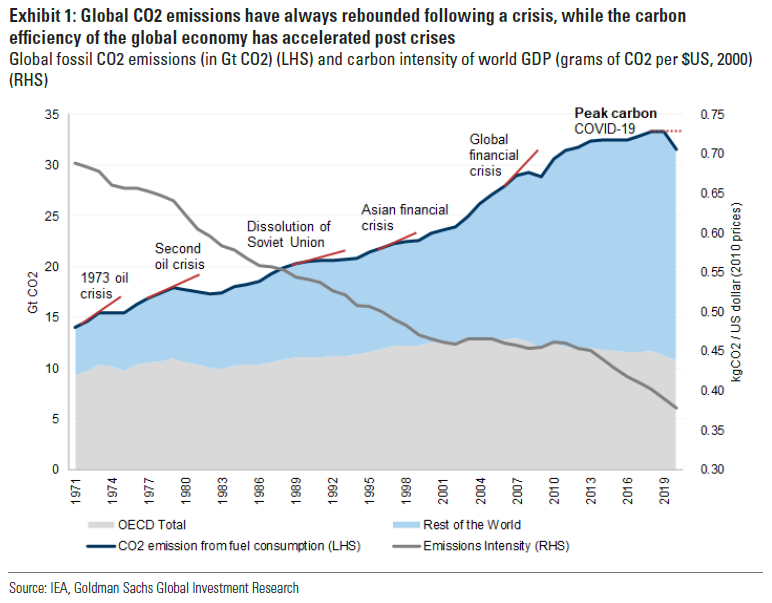
Goldman Sachs expects 2020 to witness the largest decline of CO2 emissions on record, with global energy-related COa2 emissions falling by at least 5.4%, a reduction 4-5x greater than previous crises, with potential for much larger declines dependent on virus containment and length of lockdown measures.
Historically, while emissions have always fully rebounded following a crisis, the carbon efficiency (CO2/GDP) of the underlying global economy has tended to accelerate, decreasing an average of 2% in years following a crisis vs. 1.1% in non-crisis years since 1971.
In recent years, since 2014, CO2/GDP efficiency improvements have accelerated further, averaging -2.9% led largely by the deployment of renewables in developed economies. This phenomenon has led to the flattening of energy-related carbon emissions (two-third of global GHG emissions) according to the IEA, suggesting we have already reached peak energy-related carbon in 2019, nearly a decade earlier than expected. This flattening of energy related emissions occurred despite the nearly 3% growth in global GDP, according to Goldman Sachs.
Goldman Sachs predict that global GHG emissions have likely peaked due to the continued deployment of renewables and pressure capital markets have placed on corporates to decarbonize.