
The European Parliament has adopted a resolution, calling for stopping the Nord Stream 2 project, with the document being backed by 402 lawmakers. A total of 163 members of parliament voted against the resolution, while 89 MEPs abstained.
The resolution, which is unbinding and was introduced by Latvian MP Sandra Kalniete in March, also urges to impose new sanctions on Russia and limit Moscow's access to finances and technologies, as well as to not consider the country a strategic partner.
As written in the text of the document, the Nord Stream 2 project allegedly boosts EU's dependence on Russian gas supplies and threatens the bloc's energy policy and its "strategic interests."
However, it is up to the European Union authorities to adopt further economic restrictions, including individual sanctions and access to tech.
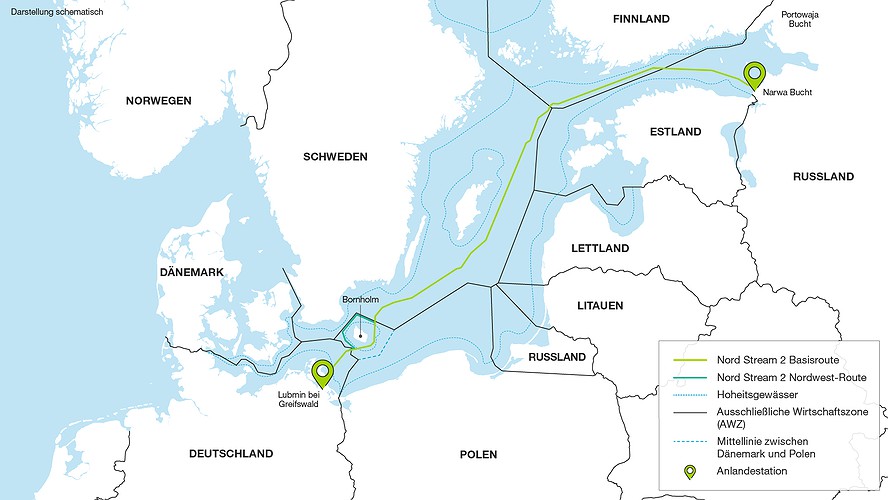
The adoption of the resolution comes just weeks after EU member states' ambassadors endorsed the provisional agreement between representatives of the Council of the European Union and the European Parliament on compromise amendments to the EU gas directive, which envisions extending internal EU market regulations to pipelines to and from non-EU countries running through Europe. This would include Nord Stream 2, which will carry gas from Russia via the Baltic Sea and a hub in Germany.
While the European Commission expects Gas Directive amendments to enter force before the completion of the Nord Stream 2 pipeline, the compromise on the matter was reached by Berlin and Paris, which had announced earlier that it would back the previously proposed regulation over its possible risks to the project. Separately, the US has repeatedly been voicing opposition to the Russian pipeline to Europe, with President Donald Trump urging the bloc member states, particularly, Germany, to buy American LNG instead. In turn, Berlin has repeatedly emphasised that it supports the project and rejected the claim that the pipeline is a threat to the European energy security.
Moscow has slammed Washington's pressure on the EU over the matter and accused the White House of unfair competition for the European gas market, while stressing that the project is purely economic. Nord Stream 2 is a joint venture of Russian gas giant Gazprom and five European companies. It aims to deliver 55 billion cubic meters (1.9 trillion cubic feet) of Russian natural gas annually to the European Union.
The European Parliament considers necessary to curtail the NordStream 2 gas pipeline project, according to the report on the state of EU-Russia political relations approved on Tuesday.
“Russia and the EU will remain key economic partners in the foreseeable future, but NordStream 2 reinforces EU dependency on Russian gas supplies, threatens the EU internal market and is not in line with EU energy policy, and therefore needs to be stopped,” the report says.
One of Gazprom’s Nord Stream -2 partners, German energy company Uniper declined to comment on the European Parliament’s report on relations with Russia, but is confident that the project will be implemented, a company representative told TASS on Tuesday.
“We will not speak out in detail on the possible resolution of the European Parliament. It is clear that we continue to adhere to our commitments on Nord Stream 2, we are convinced that it makes sense from the point of view of energy policy for Germany and for Europe against the background of reduced gas production in Europe,” the company press service said.
“We firmly believe that the Nord Stream 2 project will be implemented,” the representative said in a statement.
“The EU’s dependency on Russian gas supplies has increased since 2015,” according to the report.
The Nord Stream 2 pipeline is expected to come into service at the end of 2019. The pipeline is set to run from the Russian coast along the Baltic Sea bed to the German shore. Each of the pipeline’s two stretches will have a capacity of 27.5 bln cubic meters. The total cost of the project has been estimated at 9.5 bln euro.
The resolution puts a tough stance on Russia. It says, according to the European Parliaments website:
Parliament adopted on Tuesday a resolution by 402 votes to 163, with 89 abstentions, assessing the current state of EU-Russia political relations.
Sanctions must be prolonged
MEPs note that new areas of tension between the EU and Russia have arisen since 2015, including Russia’s intervention in Syria, interference in countries such as Libya and the Central African Republic, and continuous aggressive action in Ukraine. They also highlight Russia’s support for anti-EU parties and far-right movements, and that it keeps meddling in political elections and violating human rights in its own state.
Taking stock of these violations of international law, MEPs stress that the EU should stand ready to adopt further sanctions against Russia, especially those targeting individuals. Sanctions should be proportionate to the threats posed by Russia, they add. In December last year, the Council prolonged economic sanctions until 31 July 2019.
Addressing global challenges together
The resolution underlines that the EU should review its current Partnership and Cooperation Agreement (PCA) with Russia and limit cooperation to areas of common interest. Global challenges, such as climate change, energy security, digitalisation, artificial intelligence and the fight against terrorism call for selective engagement, MEPs say.
Closer relations will only be possible if Russia fully implements the so-called Minsk agreements to end the war in eastern Ukraine and starts respecting international law, says the text.
Response to disinformation
MEPs condemn Russia‘s disinformation campaigns and cyber attacks, aimed at increasing tensions within the EU and its member states. They are deeply concerned that the EU‘s response to propaganda and disinformation is insufficient and should be further strengthened, in particular before the upcoming European elections in May 2019. In this regard, the funding and human resources for the EU‘s East Stratcom Task Force must be substantially increased, they stress.
Threat to the neighbours
Parliament strongly denounces Russia‘s violation of the airspace of EU states, especially in the Baltic Sea region, where territorial waters and the airspace have been repeatedly breached. This disregard for international rules poses a threat to Russia‘s neighbours in the Black Sea, Baltic Sea and Medditeranean regions.
Nord Stream 2
MEPs also reiterate their concerns that the Nord Stream-2 project could reinforce the EU‘s dependence on Russian gas supplies and threaten the EU internal market.
Support to authoritarian regimes and disruptive political forces
MEPs are concerned about Russia‘s continuous support for authoritarian regimes and countries such as North Korea, Iran, Venezuela and Syria. They also regret that in order to destabilise EU candidate countries, Russia gives its support to organisations and political forces like those opposing the Prespa Agreement that has resolved the long-standing dispute on the name between the former Yugoslav Republic of Macedonia and Greece.
Russia‘s economic warfare
MEPs condemn illegal financial activities and money laundering by Russia, potentially amounting to hundreds of billions of euros being laundered through the EU every year, which poses a threat to European security and stability. The report underlines that EU countries concerned must end all 'golden visa/passport' programmes, which benefit Russian oligarchs.
Quote
"The time for nice and diplomatic language is over. There is very little room for any cooperation as long as Russia continues to occupy parts of Ukraine and attacks other European countries", , said rapporteur Sandra Kalniete (EPP, LV).
Russia disappointed
“The deepening of EU integration and coherence between its internal and external policies is the key to a more coherent, effective and successful EU external and security policy, including vis-à-vis Russia,” the report noted.
Members of the European Parliament (EP) who adopted a report on political relations with Russia lobby US interests rather those of Europe, Russian Federation Council (the upper house of parliament) Foreign Affairs Committee Chairman Konstantin Kosachev wrote on Facebook on Tuesday.
Earlier in the day, the European Parliament endorsed a report “on the state of EU-Russia political relations,” which says that the Parliament no longer considers Russia as a strategic partner. At the same time, an amendment to the report expresses hope that Russia will not leave the Council of Europe.
“The European Parliament has opposed the interests of Europe, for the resolution calls for stopping the construction of the Nord Stream 2 gas pipeline. In fact, European Parliament members are lobbying the interests of the United States and not those of the Europeans,” Kosachev pointed out.
“I won’t be surprised if in May, European voters will make many of the current anti-European lawmakers leave the European Parliament,” he added.
The senior Russian senator noted that the report had been prepared by EP member Sandra Kalniete, who is “one of the professional Russia-haters in the Parliament.” “The fact that such important documents are adopted at the initiative of — to put it mildly — biased individuals, speaks for itself, while vote statistics (402 voted in favor of the report, 163 voted against it and 89 abstained from voting) is kind of a common-sense barometer, which shows that the weather is cloudy,” Kosachev said, adding that “compared to the June 2015 vote on a similar resolution, there is a little clearing in the clouds.” In June 2015, as many as 494 European Parliament members voted in favor of an anti-Russian document, while 135 voted against it and 69 abstained, Kosachev noted.
“The authors of the new controversial document made no secret that they wanted it to be adopted before the European Parliament election, scheduled to be held in May, because Russia-haters in Brussels rightly fear they will not receive that many votes. The document itself is nothing new for it contains the same old cliches aimed at explaining why Russia can no longer be considered as the European Union’s strategic partner,” the Russian senator said.
According to him, the document is also an example of hypocrisy because it contains allegations concerning ties between the Russian government and some right-wing forces in the EU and at the same time, calls for supporting non-profit organizations active in Russia. “When you draw the Europeans’ attention to those inconsistencies, when our Temporary Commission on defending state sovereignty and preventing interference in Russia’s internal affairs catches them red-handed, they always seem to be very surprised and wonder what did they do. The resolution’s author, who condemns Russia for some alleged human rights violations, represents a country where the shameful institution of non-citizenship still exists,” Kosachev said.
The senator believes that despite attempts to find specific areas of cooperation, “the document looks hopeless.” “According to the media, an amendment supported by the Green Party, the Social-Democrats and the Alliance of Liberals and Democrats for Europe Party, which called for restoring the activities of a committee for parliamentary cooperation between the EU and Russia, was rejected. It means the European Parliament is just not ready to build dialogue and defend its positon in direct talks with with us, it just fears to face facts and a different opinion,” Kosachev said.