
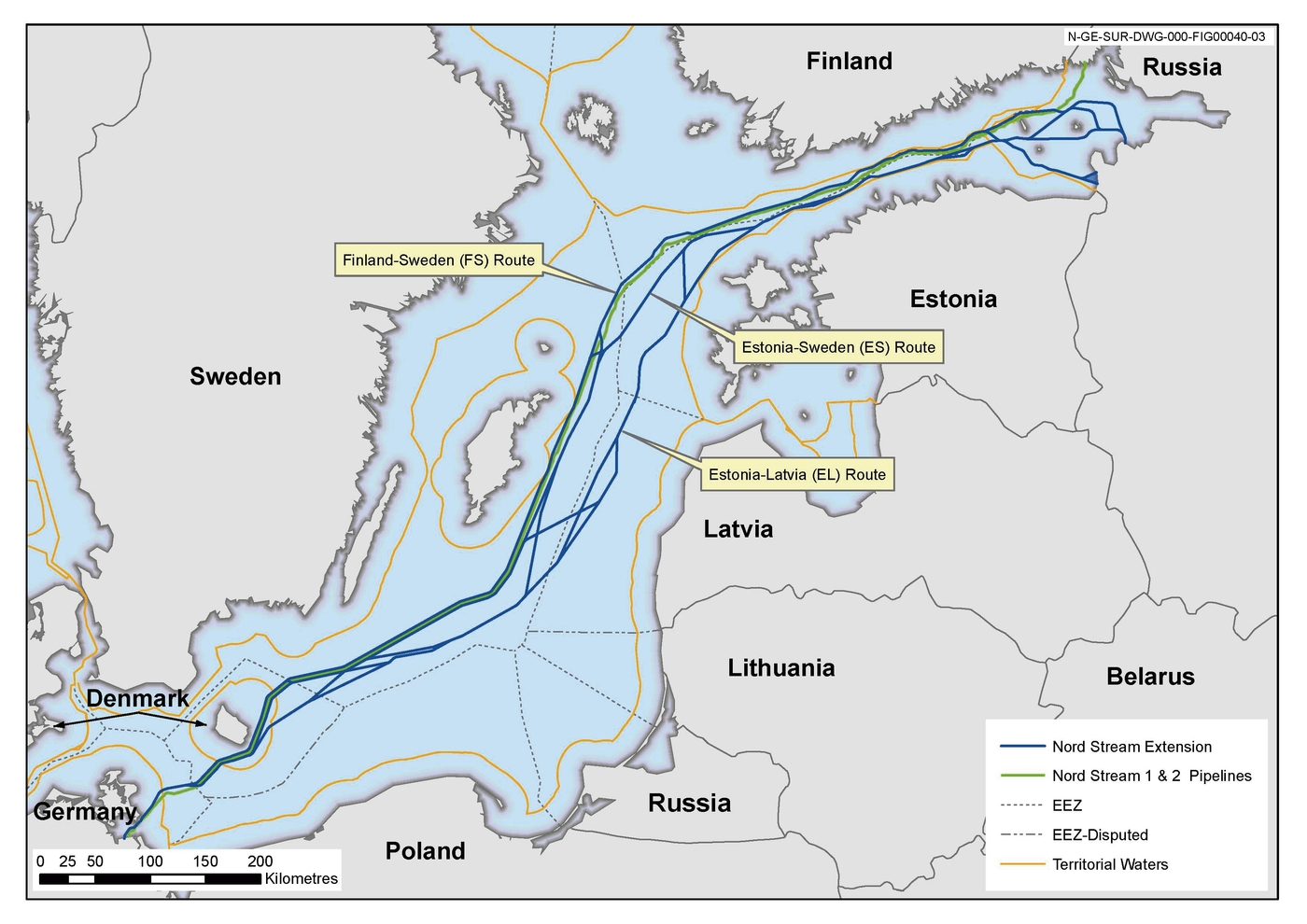
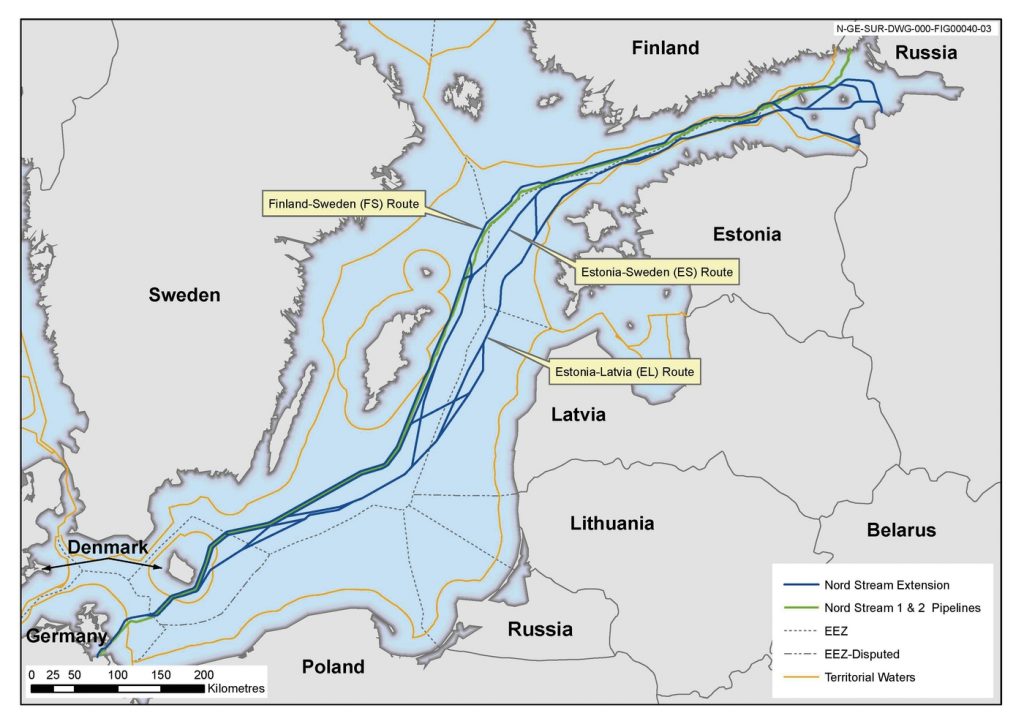
Copenhagen - March 29 (WNM/newswires) Denmark wants Nord Stream 2 to present environmental and security assessments for a south of Bornholm in the continental shelf area. This does not mean that the Danish authorities have already decided which route they might approve or might not approve regarding the controversial German-Russian pipeline. Ture Falbe-Hansen, spokesman for the Danish Energy Agency (DEA), told World News Monitor: ”There are no details regarding a timeline. When the Nord Stream 2 company provides the Danish authorities with an environment impact assessment it has to go through the normal procedure with public hearings etc. A decision from the Danish Energy Agency will depend on this process.”
Falbe-Hansen said, that “the The DEA has requested Nord Stream 2 to include a route option in the Danish continental shelf area south of Bornholm into the environmental assessment in order to ensure that all relevant routes are properly analyzed with regards to environment and safety (integrity) issues”. The option of a southern route is now open due to the border agreement between Denmark and Poland, Falbe-Hansen said.
The process of evaluation might take some time: “When the Nord Stream 2 company provides the Danish authorities with an environment impact assessment of the southern route it has to go through the normal procedure with public hearings etc. A decision from the Danish Energy Agency will depend on this process and after this an assessment will be made as to which of the two continental routes are preferable seen from an environmental and safety (integrity) perspective”, Falbe-Hansen said.
The pipeline is highly controversial. Poland opposes the project as the country wants to become an energy hub in Europe itself. The U.S. government threatens the companies involved with sanctions. Richard Morningstar from the Atlantic Council told WNM recently he thinks sanctions are on the table.
Russia does not yet see a problem with the new request from Denmark. The request will not affect the announced delivery time of the project, Russia’s Energy Minister Alexander Novak told reporters on the sidelines of the Krasnoyarsk Economic Forum on Friday, according to TASS news agency.
“No,” he said when asked a respective question.
When commenting on new amendments to the EU’s gas directive in an interview with the Rossiya-24 TV news channel, the minister said that they would have no negative impact on the project’s implementation.
“I am confident that those amendments will not have negative impact on the implementation of the Nord Stream 2 project. Obviously, that is a commercial project, in which European companies and European consumers are interested. It is being implemented, invested in, consequently, is running to the plan and the roadmap,” Novak said.
According to the minister, the new amendments are a softened version of those initially considered, and enable the regulator, on whose territory the gas pipeline passes from the offshore section to the onshore one, to independently take the decision on regulation and conformity within the country’s territorial waters.
On March 27, Naftogaz of Ukraine had written on Twitter that Gazprom had been given refusal on Nord Stream 2 route by Denmark. The statement of the DEA does not support this interpretation.
In 2018, Nord Stream 2 AG filed an application for an alternative route of the pipeline in Denmark. The need to find an alternative route to the Nord Stream 2 is linked to changes in the Danish legislation as the country adopted amendments to the law on the continental shelf in 2017. Under the amended law, the Danish Foreign Ministry may reject an application for the construction of a pipeline in the country’s territorial waters. In the case of an alternative option, the construction of the gas pipeline is regulated by the UN Convention on the Law of the Sea and the Danish authorities will no longer be able to block the project.
The initial route is still preferable for Nord Stream 2 AG, and the company still expects that it will be approved by Danish authorities.
The Nord Stream 2 pipeline is set to run from the Russian coast along the Baltic Sea bed to the German shore. Each of the pipeline’s two stretches will have a capacity of 27.5 bln cubic meters. The total cost of the project has been estimated at 9.5 bln euro. The pipeline is expected to come into service at the end of this year.