
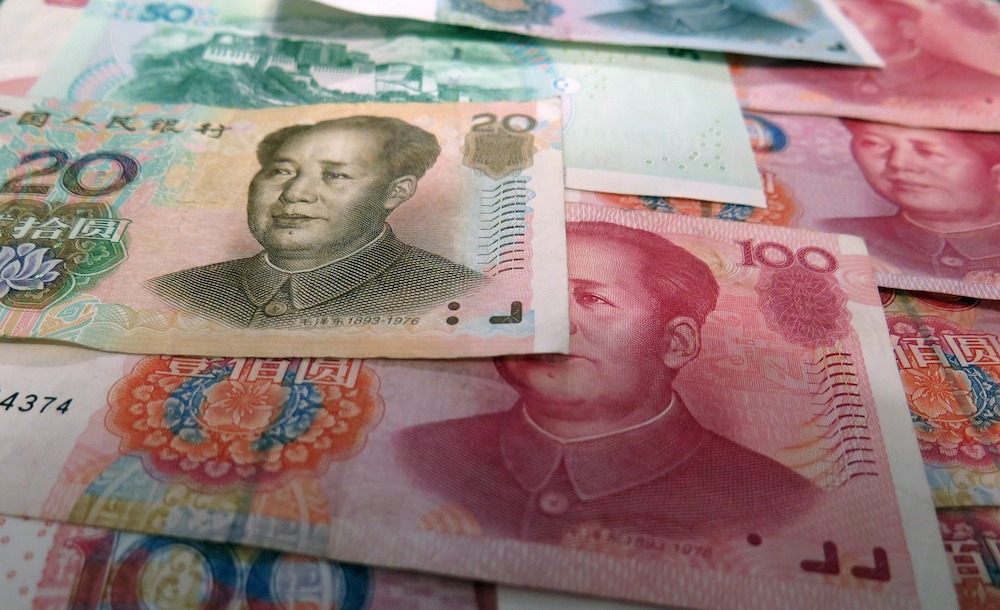
The People's Bank of China (PBOC), China's central bank, on Wednesday pumped 270 billion yuan (about 39 billion U.S. dollars) into the financial system through open market operations. To maintain reasonable and sufficient liquidity, the central bank conducted the operations with seven-day reverse repos at an interest rate of 2.55 percent.
Net liquidity injection was 250 billion yuan on Wednesday, as previous reverse repos worth 20 billion yuan became mature. A reverse repo is a process in which the central bank purchases securities from commercial banks through bidding, with an agreement to sell them back in the future.
China will keep its prudent monetary policy "neither too tight nor too loose" while maintaining market liquidity at a reasonably ample level in 2019.
A sub-index tracking banking shares lost 0.85% on the day amid ongoing uncertainty over the impact of a regulatory takeover of Baoshang Bank, a troubled regional lender. Chinese money rates rose following the takeover, but have since retreated. China's central bank made its largest daily net cash injection into the banking system in more than four months on Wednesday.
Underscoring the risk to market expectations of implicit guarantees, sources told Reuters that haircuts of as much as 30% are possible in the repayment of Baoshang's larger debts. However, shares of China's major insurance firms jumped as investors hunted for bargains in a sector whose valuations, analysts say, are attractively low. People's Insurance Group of China (PICC) surged 8.85% and China Life Insurance Co Ltd added 4.82%
China will protect the legitimate rights and interests of depositors and other clients to the greatest extent after taking over the Inner Mongolia-based Baoshang Bank, an official statement said Sunday.
The country will firmly guard against systemic risks, and keep the commercial bank's businesses uninterrupted, according to the joint statement by the People's Bank of China (PBOC) and the China Banking and Insurance Regulatory Commission (CBIRC).
Other disposal principles after the takeover include carrying out the takeover in accordance with laws and regulations, guarding against moral hazards, and minimizing the cost of disposal.
On Friday, the PBOC and the CBIRC said the joint-equity commercial bank in the Inner Mongolia Autonomous Region would be taken over due to "serious credit risks," with its businesses entrusted to the China Construction Bank (CCB). "After the takeover, Baoshang Bank has in effect obtained national credit," the statement said, adding that the principal and interest of personal savings deposits are guaranteed to the full amount, while corporate deposits are also "sufficiently guaranteed." "Judging from the situation in the past two days, Baoshang Bank branches have abundant capital, and depositors are free to deposit and withdraw," the statement said.
The PBOC and the CBIRC will maintain the normal operation of the bank by providing liquidity support, allocating sufficient cash and ensuring the smooth operation of the payment system, the statement said.
The PBOC will pay close attention to the liquidity situation of small and medium-sized banks, strengthen market monitoring and comprehensively use various monetary policy tools to maintain reasonable and sufficient liquidity in the banking system and maintain stable money market interest rates.
Both authorities will continue to increase policy support for small and medium-sized banks and promote the further improvement of their corporate governance to make the development of small and medium-sized banks healthier, the statement said.
During the entrusted period, the CCB will help improve Baoshang's corporate governance structure and risk control system and promote its normal operation and steady development.
The CCB will perform its duties as a trustee bank in accordance with the law, and build a "firewall" against interest conflicts with Baoshang, without grabbing Baoshang's customer resources or engaging in any improper related-party transactions, the statement said.
The overnight Shanghai Interbank Offered Rate (Shibor), which measures the borrowing cost of China's interbank market, decreased 26.9 basis points to 2.491 percent Wednesday. The seven-day rate dropped 3.8 basis points to 2.785 percent. The one-month rate went up 0.2 basis points to 2.818 percent, and the one-year rate rose 0.1 basis points to 3.206 percent. Shibor is a simple, no-guarantee, wholesale interest rate calculated by arithmetically averaging interbank lending rates offered by a price quotation group of 18 commercial banks, with the four highest and four lowest quotations excluded.
Benchmark lending rates
China’s central bank is studying whether to scrap official benchmark lending rates as the country moves into the last lap in its long-running effort to liberalize interest rates, People’s Bank of China Governor Yi Gang said this month.
“The lending rate has actually been liberalized, but there is still room to explore further reform such as stopping the release of benchmark lending rates,” Yi said May 18 at a forum in Beijing, according to an article published Tuesday by the official Securities Journal. He also expressed confidence in the stability of the yuan despite recent downward pressure on the currency.
The central banker’s comment was the latest signal that China is gearing up to make interest rates more market-oriented. The country has been moving in that direction since 1996, but a two-track system remains. One track involves interest rates set largely by the market, such as the seven-day interbank pledged repo rate. The other track refers to benchmark deposit and lending interest rates, which are set by the central bank.