
LONDON/FRANKFURT, September 12 (Reuters/WNM) - The euro skidded below $1.10 on Thursday after the European Central Bank cut interest rates and unexpectedly relaunched a quantitative easing programme as well to boost the region's economy.
Investors had expected a rate cut at Thursday's meeting but there was some uncertainty as to whether policymakers would restart a QE programme after some ECB members expressed doubt in recent weeks about the need to relaunch asset purchases.
The euro, after initially rising, dropped sharply to as low as $1.0955, the day's low and down 0.5% on the session, as investors digested news of the rate cut and relaunch of QE. The euro hit a 28-month low earlier this month of $1.0926.
The single currency also weakened against the Swiss franc and Japanese yen.
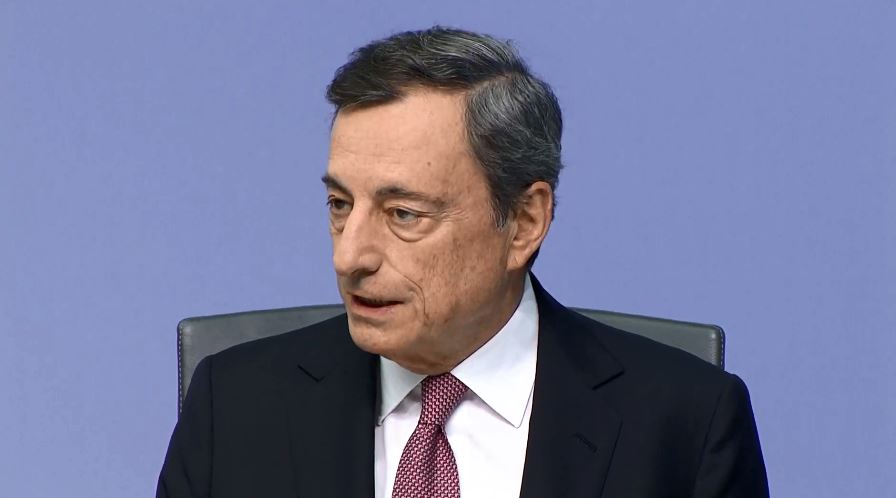
ECB President Mario Draghi gives his press conference at 1230 GMT, where investors will be looking for signals of further rate cuts and whether policymakers plan to tweak their inflation targeting framework.
Thursday's meeting was the first in a series of major central bank events, with Federal Reserve and Bank of Japan meetings next week.
Stephen Gallo, European Head of FX Strategy at BMO Capital Markets, said that if the ECB prepared the market for significant rate cuts ahead, "that would be quite dovish, quite bearish" for the euro.
Euro/dollar overnight implied volatility had soared to its highest since mid-2018 in the run-up to Thursday's policy statement.
The dollar rose against a basket of currencies and was last up 0.2% at 98.568.
RISK RALLY
Elsewhere in forex markets, a rebound in risk sentiment supported the Chinese yuan, Australian dollar, export-driven currencies across Asia and emerging market currencies.
After a difficult August in which concerns about a global recession sparked a scramble into safer assets, markets have rallied this month, encouraged by easing trade tensions and by receding fears of a no-deal Brexit for now.
China on Wednesday exempted a basket of U.S. goods from its tariffs, while U.S. President Donald Trump said in a tweet he would delay a scheduled tariff hike by two weeks in October.
The Aussie hit a six-week high of $0.6887 and the offshore Chinese yuan rose as much as 0.5% to a three-week high of 7.0737 per dollar.
The Japanese yen, the go-to safe haven currency for fearful investors, fell to a six-week low against the dollar. The yen breached the 108 mark in Asian trade and was last at 107.80 yen per dollar.
It had hit a seven-month high of 104.46 last month.
Sterling was little changed . The pound rocketed to a six-week high against the dollar on Monday as investors welcomed the British parliament's move to block a no-deal Brexit on Oct. 31.
Despite the more positive mood in risk assets this week, analysts expressed caution about its sustainability.
"The bigger picture is one of a very tense geopolitical environment that is unlikely to be rectified quickly," BMO's Gallo said.
The announcment of the ECB:
At today’s meeting the Governing Council of the ECB took the following monetary policy decisions:
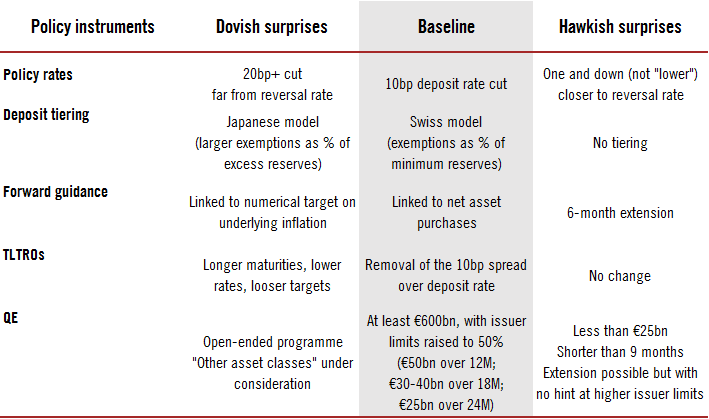
(1) The interest rate on the deposit facility will be decreased by 10 basis points to -0.50%. The interest rate on the main refinancing operations and the rate on the marginal lending facility will remain unchanged at their current levels of 0.00% and 0.25% respectively. The Governing Council now expects the key ECB interest rates to remain at their present or lower levels until it has seen the inflation outlook robustly converge to a level sufficiently close to, but below, 2% within its projection horizon, and such convergence has been consistently reflected in underlying inflation dynamics.
(2) Net purchases will be restarted under the Governing Council’s asset purchase programme (APP) at a monthly pace of €20 billion as from 1 November. The Governing Council expects them to run for as long as necessary to reinforce the accommodative impact of its policy rates, and to end shortly before it starts raising the key ECB interest rates.
(3) Reinvestments of the principal payments from maturing securities purchased under the APP will continue, in full, for an extended period of time past the date when the Governing Council starts raising the key ECB interest rates, and in any case for as long as necessary to maintain favourable liquidity conditions and an ample degree of monetary accommodation.
(4) The modalities of the new series of quarterly targeted longer-term refinancing operations (TLTRO III) will be changed to preserve favourable bank lending conditions, ensure the smooth transmission of monetary policy and further support the accommodative stance of monetary policy. The interest rate in each operation will now be set at the level of the average rate applied in the Eurosystem’s main refinancing operations over the life of the respective TLTRO. For banks whose eligible net lending exceeds a benchmark, the rate applied in TLTRO III operations will be lower, and can be as low as the average interest rate on the deposit facility prevailing over the life of the operation. The maturity of the operations will be extended from two to three years.
(5) In order to support the bank-based transmission of monetary policy, a two-tier system for reserve remuneration will be introduced, in which part of banks’ holdings of excess liquidity will be exempt from the negative deposit facility rate.