
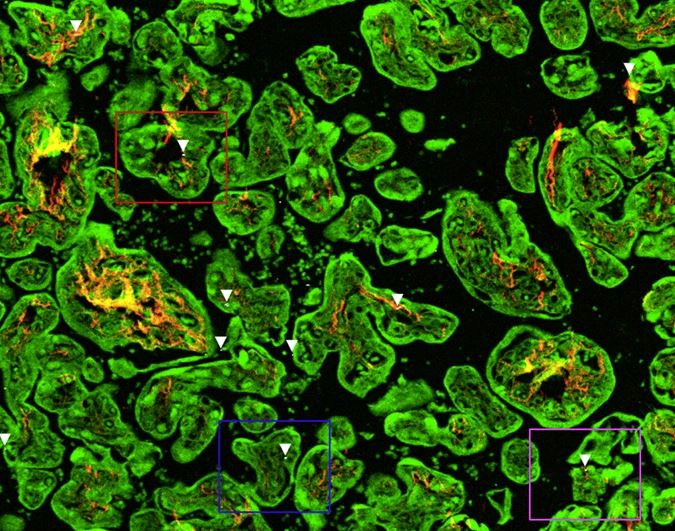
A new study has found air pollution particles on the foetal side of placentas. This means that unborn babies are directly exposed to the black carbon. The consequences are severe.
BRUSSELS, September 18 (WNM) - The research is the first study to show the placental barrier can be penetrated by particles breathed in by the mother. It found thousands of the tiny particles per cubic millimetre of tissue in every placenta analysed.
"There's no doubt that air pollution harms a developing baby," said Amy Kalkbrenner, an environmental epidemiologist at the University of Wisconsin-Milwaukee, who was not involved in the work, in an interview with Science News. The new study suggests "air pollution itself is getting into the developing baby," Kalkbrenner said.
The research suggests the particles themselves may be the cause for miscarriages, premature births and low birth weights , not solely the inflammatory response the pollution produces in mothers.
Damage to foetuses has lifelong consequences and Prof Tim Nawrot at Hasselt University in Belgium, who led the study, told The Guardian: “This is the most vulnerable period of life. All the organ systems are in development. For the protection of future generations, we have to reduce exposure.” He said governments had the responsibility of cutting air pollution but that people should avoid busy roads when possible.
The research, published in the journal Nature Communications, examined 25 placentas from non-smoking women in the town of Hasselt. It has particle pollution levels well below the EU limit, although above the WHO limit. Researchers used a laser technique to detect the black carbon particles, which have a unique light fingerprint.
Full study; https://www.nature.com/articles/s41467-019-11654-3