
Vienna, September 30 (WNM) - Voters in Austria have put environmental and climate issues on the political agenda.
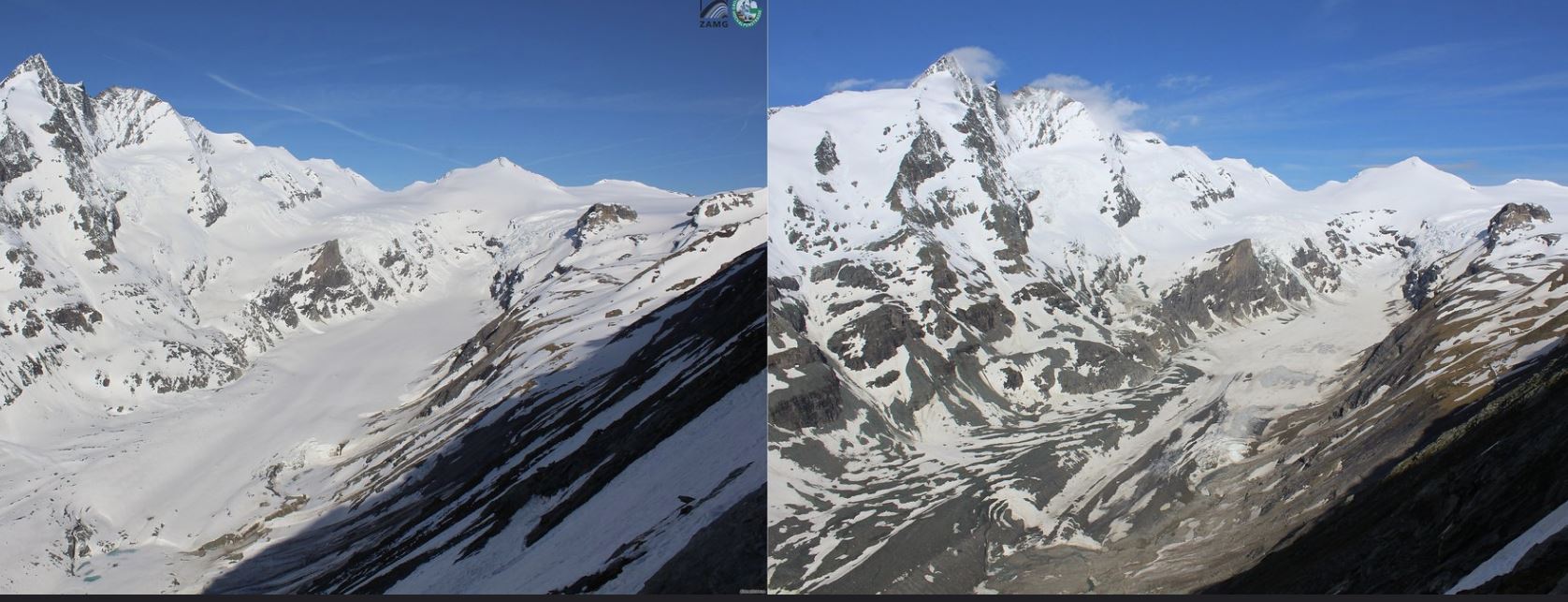
The Austrians, traditionally a people who care about nature, see a need for action with record heat waves in summer, the retreat of glaciers and dying forests. Austrians can watch the disappearance of an alpine icon live: The Pasterze, Austria's largest glacier at the foot of the Grossglockner, will disappear completely by 2050, predicted the Central Institute for Meteorology and Geodynamics (ZAMG) as early as 2015. According to ORF, glacier researcher Bernhard Hynek, the glacier tongue will have melted by the end of this century under the current climate: "With a maximum ice thickness of currently around 200 metres and an average loss of ice thickness of five metres per year, it is to be expected that the glacier tongue of the Pasterze will have almost completely disappeared by 2050".
These and other developments have brought the Greens back to parliament with 14 percent of the votes and a historic success.
The result makes the faction a serious possible coalition partner for the victorious ÖVP.
For many decades, the Austrian Greens have played a pioneering role in environmental issues. Thanks to this commitment, they have become a fixed political factor. Their rise began in the 1980s with the successful protests against the "Hainburger Au" and against nuclear power. With a referendum, Austria prevented the commissioning of the completed Zwentendorf nuclear power plant. That was when the Greens began their triumphal march as a political force.
"The thematic development has helped the Greens a lot, I am thinking here of Greta Thunberg and the climate protests," said Thomas Drozda, Managing Director of the Social Democrats, in a television interview with ORF about the defeat. "This is an area where the Greens have been credible for 20 or 25 years."
Although all the polls showed that the climate and environment issues are booming among Austrians, most parties have not taken developments seriously. The SPÖ more or less overslept the topic. FPÖ leader Norbert Hofer made fun of Greta Thunberg at the last TV discussion before the election, which probably cost him sympathy.
This makes a political marginal movement in the conservative country a leading candidate for a role in the government and could be a sign of what can still be expected in Germany. Green Party leader Werner Kogler explicitly pointed out on election night that he had already spoken to German Green Party leader Robert Habeck twice on that day.
ÖVP leader Sebastian Kurz will find it difficult to ignore the Greens, even if there are considerable differences, especially with regard to sensitive social issues such as migration.
For the SPÖ, the party's influential manager Gerhard Zeiler said that the SPÖ must insist on a CO2 tax. Zeiler is the former secretary of a Social Democratic Federal Chancellor.
The change of course can already be seen.
Last week, the five Austrian parties agreed on a 540 million euro package to promote investment in renewable energies. While there is a broad consensus that climate change is real and that the economy needs to be re-equipped, the parties are making different proposals to tackle the problem.
The People's Party has promoted the development of hydrogen as a fuel in transport and heavy industry, while the Greens have sought to reduce the number of cars driving in cities and increase public transport.
Party leader Werner Kogler said he was willing to negotiate with Kurz "as long as climate protection is at the centre of politics".
"Climate protection has arrived in the middle of society", said green politician Birgit Hebein in an interview with ORF. She thanked the protest movement launched by Swedish activist Thunberg a year ago. "It is crucial that climate change is tackled at all levels.